Butterfly 3D Animal SVG Files for Laser: A Comprehensive Evaluation of Digital Craft Assets
The intersection of digital design and physical fabrication has created a robust market for laser-cut craft assets. Among the various options available, Butterfly 3D Animal SVG Files for Laser represents a specific niche focused on precision, multi-format compatibility, and ease of assembly. For hobbyists, educators, and small business owners, understanding the technical specifications and practical applications of these files is essential before making a purchase decision. This evaluation breaks down what buyers receive, how the file structure supports different manufacturing methods, and whether this particular asset aligns with your project requirements.
Digital-Only Delivery and File Structure
A fundamental aspect of modern digital craft resources is the delivery method. It is critical to understand that Butterfly 3D Animal SVG Files for Laser consists entirely of digital downloads; no physical items will be sent. Your digital files are available to download immediately after the purchase is completed, allowing for rapid prototyping without shipping delays. The product page explicitly states that you will receive vectoral files in a comprehensive suite of document types:
- AI (Adobe Illustrator): Ideal for users who need to edit node points, adjust line weights, or integrate the butterfly design into larger composite illustrations.
- DXF (AutoCAD): A standard format for many industrial and semi-industrial laser cutters, ensuring broad compatibility with CNC software.
- SVG (Scalable Vector Graphics): The most common format for hobbyist laser engravers and cutters, offering easy scalability without loss of resolution.
- EPS (Encapsulated Postscript): Useful for professional printing workflows and legacy design software.
- PDF (Portable Document Format): Provides a stable preview and can often be used directly by machines that support PDF input, though vector editing may require conversion.
This multi-format approach distinguishes the product from competitors who may only offer a single file type. By providing both AI and DXF files, the creator ensures that users with varying levels of software proficiency and hardware constraints can utilize the design effectively. However, users should always verify their specific machine’s supported formats before purchasing, as some entry-level devices may have limited compatibility.
Material Thickness and Precision Engineering
One of the most significant value propositions of these files is the inclusion of variations for different material thicknesses. Laser cutting is not a one-size-fits-all process; the clearance between parts must account for the kerf (the width of the material removed by the laser) and the thickness of the substrate. The download includes drawings specifically tailored for:
- 3 mm materials: Suitable for thicker woods like birch plywood or acrylic sheets, offering a sturdy, substantial feel.
- 3.2 mm (1/8 inch) materials: A standard thickness in many craft stores, requiring precise tolerance adjustments to ensure pieces fit together without being too loose or too tight.
- 4 mm materials: Used for heavier-duty projects where structural integrity is paramount.
This attention to detail suggests that the designer has tested the files across multiple substrates. When evaluating similar options, many generic SVG files assume a standard 3mm thickness and provide no alternatives. If you primarily work with 4mm MDF or 3.2mm basswood, finding a file that already accounts for these dimensions saves significant time in trial-and-error testing. The tradeoff is that if you use a non-standard thickness, such as 2mm paper-thin cardstock, you may need to manually scale or adjust the joinery in your vector software.
Assembly Process and Educational Support
Constructing a 3D model from flat vector files requires patience and precision. To mitigate the learning curve, the package includes an assembly video. This visual guide is crucial for understanding the sequence of insertion, particularly for complex interlocking joints common in 3D animal models. Without clear instructions, users might struggle with the orientation of tabs and slots, leading to wasted material.
The inclusion of a video tutorial adds tangible value beyond the raw files. It transforms the product from a simple set of lines into a guided experience. For beginners, this reduces frustration and increases the likelihood of a successful first build. For experienced makers, it serves as a quick reference to confirm the designer’s intended assembly logic, which can sometimes differ from intuitive guesses.
Physical Dimensions and Scale Considerations
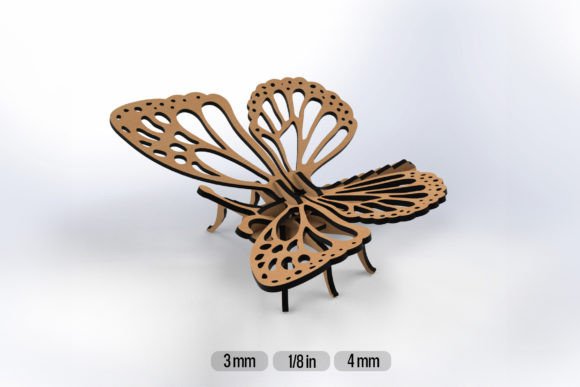
Before starting a project, evaluating the final scale is vital. The assembled Butterfly 3D Animal SVG Files for Laser result in a model with the following dimensions:
- Height: 63 mm (2.5 inches)
- Width: 160 mm (6.3 inches)
- Length: 139 mm (5.5 inches)
These dimensions place the butterfly in the category of medium-sized decorative objects. At 6.3 inches wide, it is large enough to be a focal point on a shelf or desk but small enough to fit within the bed of most desktop laser cutters (such as xTool, Glowforge, or Ortur models). This size is particularly advantageous because it minimizes material waste; a single sheet of 12x12 inch or A4 material can often yield multiple units, depending on nesting strategies.
However, potential buyers should consider the display context. If you are creating jewelry or miniature dioramas, this scale may be too large. Conversely, if you are looking for wall art or large-scale installations, you might find the 6-inch width limiting. In such cases, while the SVG files are scalable, the complexity of the internal joints may become difficult to cut accurately at very large sizes due to laser power limitations and material warping. Therefore, this product is best suited for tabletop decor, educational models, or small gift items.
Comparison with Alternative Formats
When comparing Butterfly 3D Animal SVG Files for Laser to other categories of craft resources, several distinctions emerge. Unlike pre-assembled wooden kits sold online, these files offer unlimited reproduction rights (subject to the license terms), allowing you to create as many copies as needed for personal use or small business sales. Unlike 3D printable STL files, which require expensive resin or filament and post-processing cleanup, laser-cut vector files offer a cleaner finish with less mechanical labor.
Furthermore, compared to free downloadable SVGs found on community forums, the paid nature of this product often correlates with higher quality control. Free files frequently contain overlapping paths, ungrouped elements, or incorrect joinery that prevents proper assembly. The provision of multiple thickness variants in this package is a level of service rarely found in free repositories. However, users should weigh this against the cost, especially if they only plan to cut one-off projects using a single material thickness.
Decision Factors: Is This the Right Choice?
Determining whether to purchase these files depends on your specific workflow and goals. The product is an excellent fit for:
- Laser Engraving Hobbyists: Who want to add dimensional depth to their projects without designing from scratch.
- Educators: Who need reliable, reproducible models for STEM classes focusing on geometry and engineering principles.
- Small Business Owners: Looking for unique, customizable home decor items that can be produced efficiently on demand.
Conversely, you might seek an alternative if:
- You lack access to a laser cutter or CNC router. While the files are digital, they require specialized machinery to produce.
- You prefer 3D printed models. If your equipment is limited to FDM or SLA printers, these vector files will not be directly usable without conversion.
- You require extremely large-scale architectural models. The fixed joint design may not scale well beyond its intended proportions.
Conclusion
Butterfly 3D Animal SVG Files for Laser offers a well-rounded solution for those entering the world of 3D laser crafts. Its strength lies in its versatility—supporting multiple material thicknesses and file formats—and its user-friendly assembly process, aided by instructional videos. The specific dimensions make it ideal for desktop-friendly displays. While it requires an initial investment in laser equipment, the digital nature of the product provides long-term value through unlimited reuse. For anyone seeking a high-quality, ready-to-cut butterfly model that balances aesthetic appeal with technical reliability, this resource stands out as a practical and efficient choice.