Polygonal Bear 3D Papercraft: A Modern Twist on Traditional Paper Sculpture
In a world dominated by digital screens and mass-produced decor, there is a quiet resurgence of appreciation for tactile, handmade objects. Among the growing community of paper craft enthusiasts, few items have captured the imagination quite like the Polygonal Bear 3D Papercraft. This isn’t just a simple origami figure; it is a sophisticated low-poly paper sculpture that bridges the gap between geometric art and sentimental gifting. Whether you are looking to add a unique touch to your home office or seeking a meaningful, personalized gift for Valentine’s Day, this printable PDF template offers a compelling blend of challenge and reward.
The Intersection of Geometry and Sentiment
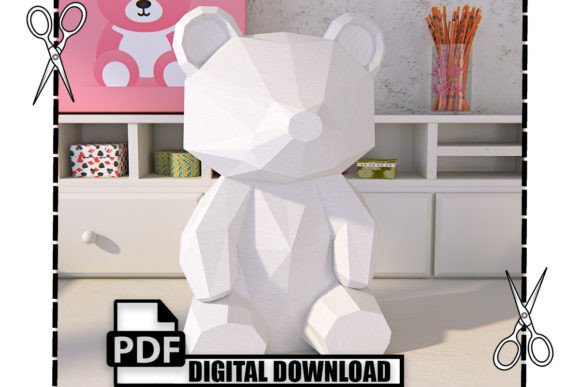
Low-poly design has become a staple in modern graphic design, video games, and architectural modeling due to its clean lines and minimalist aesthetic. Translating this style into three-dimensional papercraft creates a striking visual effect. The Polygonal Bear 3D Papercraft model utilizes sharp angles and flat planes to construct a recognizable, yet abstract, form of a bear. When assembled correctly, the facets catch light differently depending on the viewing angle, giving the static object a dynamic presence.
For many creators, the appeal lies in the contrast between the cold, mathematical precision of the geometry and the warm, fuzzy connotations of a teddy bear. It transforms a symbol of childhood comfort into an object of contemporary art. This duality makes it particularly appealing to adults aged 20–50 who appreciate modern design trends but still value the emotional resonance of traditional gifts. It is not merely a toy; it is a conversation piece that signals creativity and effort.
Real-World Applications and Use Cases
While the primary draw of the Polygonal Bear 3D Papercraft is the act of creation itself, its utility extends far beyond the crafting table. Understanding where this model fits into daily life helps clarify why it has gained such traction among hobbyists and professionals alike.
Personalized Gifting and Romance
The most immediate application for this model is as a bespoke gift. In an era where store-bought chocolates and generic cards often feel impersonal, a hand-assembled paper sculpture stands out. The prompt suggests using this for Valentine’s Day, and for good reason. Creating a "captivating low poly Valentine’s Day Bear" requires time, patience, and skill—elements that convey care more effectively than money can.
Imagine presenting this to a partner who loves design, technology, or DIY projects. The unboxing experience is part of the charm: they receive a flat PDF file (if sent digitally) or a carefully packaged kit, and the journey from print to finished product becomes part of the shared memory. For long-distance relationships, sending the digital template allows the recipient to build their own version, creating a synchronized activity despite the distance.
Workspace Decor and Desk Toys
For remote workers, students, or creative professionals, desk clutter is a common issue. Bulky statues take up space, while flat pictures lack depth. The dimensions of this specific model—standing at 463 mm in height, with a width of 290mm and depth of 269mm—make it substantial enough to be noticed but compact enough to fit on a standard bookshelf or corner of a desk.
The geometric nature of the bear complements modern interior styles, particularly those favoring Scandinavian minimalism or industrial chic. It serves as a focal point in a room without overwhelming it. Furthermore, the assembly process acts as a form of mindfulness. In high-stress environments, spending four hours focusing on folding and gluing small pieces can serve as a meditative break from screen fatigue.
Educational Tool for STEM Concepts
Educators and parents might find unexpected value in the Polygonal Bear 3D Papercraft as a tangible lesson in geometry and spatial reasoning. With 74 individual pieces and 19 pages of templates, the project introduces complex concepts like nets, polyhedrons, and structural integrity.
Teaching older children or teenagers about 3D modeling becomes less abstract when they are physically constructing the shape. They learn how 2D surfaces fold to create 3D volume. This hands-on approach reinforces mathematical principles in a way that textbooks cannot. It also introduces the basics of engineering, as users must understand which tabs go where and how tension affects the final structure.
Navigating the Assembly Process
It is crucial to set realistic expectations before starting. This is not a weekend afternoon project for beginners. The difficulty level is marked as advanced, and the estimated assembly time is approximately 4 hours. Success depends heavily on preparation and the right tools.
Material Considerations
The choice of paper significantly impacts the final result. While standard printer paper works for practice runs, the recommended materials are A4 paper, colored cardstock, or thin cardboard weighing between 200g-300g (90lb-110lb). Thicker paper holds folds better and gives the bear a sturdier, more premium look. However, thicker paper requires sharper tools and more precise cutting.
- Printer: A reliable inkjet or laser printer is essential for clear, crisp lines. Faded lines lead to misaligned cuts.
- Cutting Tools: Scissors are sufficient for rough cuts, but a craft knife and cutting mat are highly recommended for precision, especially around the small tabs used for gluing.
- Adhesive: PVA paper glue is the standard choice. White glue can be messy, so applying it sparingly with a toothpick or fine brush helps prevent warping the delicate paper edges.
The Step-by-Step Reality
The process follows a logical sequence: Print, Cut, Fold, then Assemble. Printing all 19 pages accurately is the first hurdle. Users should ensure their printer settings are set to "Actual Size" or "100%" scale, as scaling errors will cause pieces to not fit together. Cutting out 74 pieces is tedious but meditative. Folding along the pre-printed crease lines is where the shape begins to emerge. Finally, the assembly phase requires patience. Gluing one facet at a time demands a steady hand and a bit of drying time between steps.
Strengths and Limitations
Like any craft, the Polygonal Bear 3D Papercraft has distinct advantages and potential drawbacks. Its greatest strength is its accessibility. As a digital template in PDF format, it offers instant download availability. There is no shipping wait time, no international customs delays, and no risk of the package being crushed during transit. You can start crafting minutes after purchase.
Another advantage is customization. By choosing different colored cardstocks—perhaps a deep red for Valentine’s Day, or a soft pastel for a nursery—you can tailor the aesthetic to any occasion. The low-poly style is forgiving of minor imperfections; unlike smooth-surface sculptures, slight gaps or uneven folds are masked by the angular design.
However, limitations exist. The advanced difficulty means frustration is a possibility. If a tab breaks or a fold is made incorrectly, repairing it can be difficult without leaving visible marks. Additionally, the final model is made of paper. It is not durable against water, direct sunlight (which may fade colors), or rough handling. It is a display piece, not a toy for pets or small children. Proper placement in a dry, shaded area is necessary to preserve its longevity.
Why Choose This Specific Model?
With countless papercraft models available online, why settle on the Polygonal Bear 3D Papercraft? The combination of size, complexity, and aesthetic appeal strikes a balance that appeals to serious crafters. It is large enough to be impressive but manageable enough to complete in a single dedicated session. The inclusion of a manual within the PDF ensures that even if you are new to 3D papercraft, you have guidance throughout the process.
Ultimately, this project is about more than just the end result. It is about the slow, deliberate act of making something with your hands. In a fast-paced digital world, taking four hours to cut, fold, and glue a geometric bear is a radical act of slowness. It results in a beautiful, tangible object that carries the imprint of your time and attention—a quality that is increasingly rare and valuable.
Whether you are a seasoned papercrafter looking for a new challenge, a designer seeking inspiration for physical manifestations of digital art, or someone wanting to express love through labor-intensive craftsmanship, this model offers a rich, rewarding experience. The Polygonal Bear 3D Papercraft is not just a template; it is an invitation to pause, focus, and create something uniquely yours.